


Blog
Biomass – a useful tool in assessing the quality of a ma...

Dr Chris Ashelby, principal marine scientist at our Letchworth marine laboratory looks back on ten amazing years.


A microscope imaging setup at Letchworth lab
When looking for a group of world-class marine biologists, you’d be forgiven for not starting your search in Letchworth Garden City. Famed for being the world’s first ‘Garden City’, the location of the UK’s first roundabout, home to a population of about 25,000 black squirrels since their first UK siting in the town in 1912 and situated in the land-locked county of Hertfordshire, Letchworth is about as far from the sea as you can get, being almost 50 miles from the nearest coastline, as the crow flies.
The latest Global Ocean Science Report revealed that Norway has by far the highest number of ocean scientists per capita with 364 ocean scientists per million inhabitants[1]. For a country with one of the longest coastlines in the world, this may not be entirely surprising. But thanks to APEM’s marine laboratory, land-locked Letchworth boasts a density of marine biologists two and a quarter times greater than Norway!
For every thousand inhabitants of Norway there are 0.36 ocean scientists (a term that encompasses a great many disciplines, including marine biologists) whereas Letchworth boasts an impressive 0.81 marine biologists per one thousand inhabitants. In anatomical terms, you would get just the legs of an ocean scientist for each one thousand Norwegians but all except the arms of a marine biologist per one thousand Letchworthians. This surely must put Letchworth in contention for boasting the highest density of marine biologists of any town!

Services APEM has provided across the globe
Ten years ago, APEM established its marine laboratory in Letchworth. Whilst APEM had had marine laboratory capabilities since the early 2000’s, the establishment of a dedicated marine laboratory facility marked a real step-change in capacity for processing marine samples, enabling more agility to respond to the needs of our clients, coupled with faster turnaround times.
Over the last ten years, APEM’s laboratory staff have conducted surveys, sample analysis and reporting for large-scale projects related to renewable energy, interconnectors, oil and gas decommissioning, aquaculture, nationally significant infrastructure projects (NSIPs), aggregates, routine monitoring, marine conservation zones (MCZs), marine protected areas (MPAs), marine non-native species, and many more besides. APEM’s marine lab have not just limited themselves to coastal waters and estuaries of the UK having analysed samples from across the globe including West Africa, East Africa, South America, tropical eastern Pacific, Caribbean, the Southern Ocean, Barents Sea, throughout Northern Europe, Mediterranean Sea, and Middle East and covering everything from the high-water mark to depths of more than 2,000 m. This has equated to £10m revenue over 10 years.
The Letchworth team is now one of the largest and most experienced teams dedicated to the daily analysis of marine biological samples. Since the establishment of the Letchworth laboratory, APEM’s staff have processed more than 25,000 benthic, epibenthic, phytoplankton, zooplankton and ichthyoplankton samples. They have extracted, identified and counted more than 65,000,000 individual specimens belonging to more than 5,000 different taxa. Although biomass analysis is not a requirement of every project, the team have also weighed approximately 100kg of animals, quite a feat when many individuals weigh less than 0.0001g!

A close up under the microscope of Prochaetodermatidae
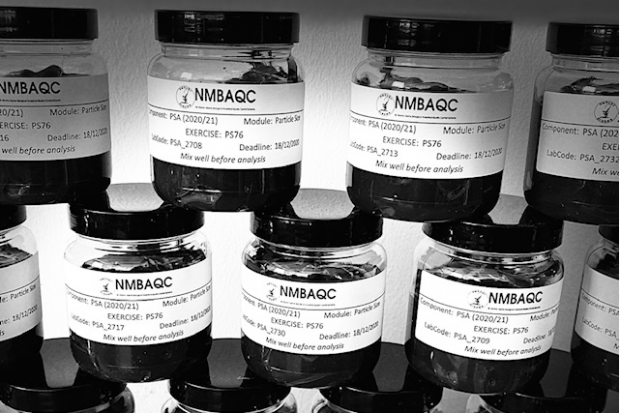
Quality is at the heart of everything that APEM do, and the marine lab is no exception to this. In the world of marine sample analysis, the gold standard for measuring quality is the North-East Atlantic Marine Biological Analytical Quality Control Scheme (NMBAQC Scheme). APEM’s marine laboratory not only participates fully in the NMBAQC Scheme but administers the benthic invertebrate, particle size, fish and macroalgae components of the Scheme. Set up in 1994, the Scheme provides quality control and assurance to the macrobenthic invertebrate elements of the Clean Seas Environmental Monitoring Programme (formerly the NMMP). It aims to develop and promote best practice in relation to sampling and analysis procedures through a range of training exercises, workshops and literature guides. This means that APEM are setting and monitoring the standard for quality for all components of routine benthic surveys in Northern Europe.

A Hamon Grab being used over water
Likewise, maintaining themselves at the forefront of scientific research is important to APEM’s staff and underlines our scientific integrity. The laboratory has a large in-house museum collection that houses voucher specimens for all of our projects. The collection currently contains more than 80,000 vials, containing more than 5,000,000 specimens of more than 5,000 taxa, and is used to improve data consistency and verify identifications. Specimens of interest have been shared with international experts and national museums to further scientific research. Over the last ten years the laboratory team themselves have also published 19 scientific papers, describing two new species, reporting six non-native species as new to Britain and recording several other species in British waters that had not previously been found here, as well as examining statistical methods for comparing particle size data.
All in all, it’s been a busy ten years and with no sign of slowing down. Happy anniversary Letchworth!
[1] https://unesdoc.unesco.org/ark:/48223/pf0000375147/PDF/375147eng.pdf.multi

APEM’s marine BioLabs have several years of experience biomassing organisms from different habitats from all over the world
+ Read more

Watch specialists Katie O’Shaughnessy, Randal Counihan and Dr Chris Ashelby deliver this webinar
+ Read more

APEM have issued draft standard recording policies for north-east Atlantic macrobenthic samples, including a Taxonomic Discrimination Protocol (TDP)
+ Read more
PS analysis plays a fundamental role in classifying sedimentary environments and has a wide range of applications in many fields
+ Read more