
The Freshwater pearl mussel (Margaritifera margaritifera) is a protected species, which plays an important role in maintenance of good water quality. Found in shallow, clean, fast-flowing streams and rivers, usually with a healthy population of salmonids.
As their name suggests, freshwater pearl mussels may contain a small pearl, which in the past was highly sought after for jewellery.
Today, freshwater pearl mussels are in decline due to factors such as poor water quality (including nutrient enrichment which also affects the numbers of host fish), habitat removal and alteration through development, drainage schemes, flow regulation, illegal “pearl fishing” and poor fisheries management.
They are found throughout the UK and Ireland and listed on Annexes II and IV of the EC Habitats Directive and Appendix II of the Bern Convention and is fully protected under Schedule 5 of the Wildlife Countryside Act 1981 and the Wildlife Order (Northern Ireland) 1985.
Larval stage freshwater pearl mussels (Glochidia) attach themselves to juvenile salmonids, effectively ‘hitching a ride’ on their host fish and facilitating wider distribution around bodies of water. Construction and development that risk disturbance of these fragile populations require specialist surveys to identify the presence of freshwater pearl mussel.
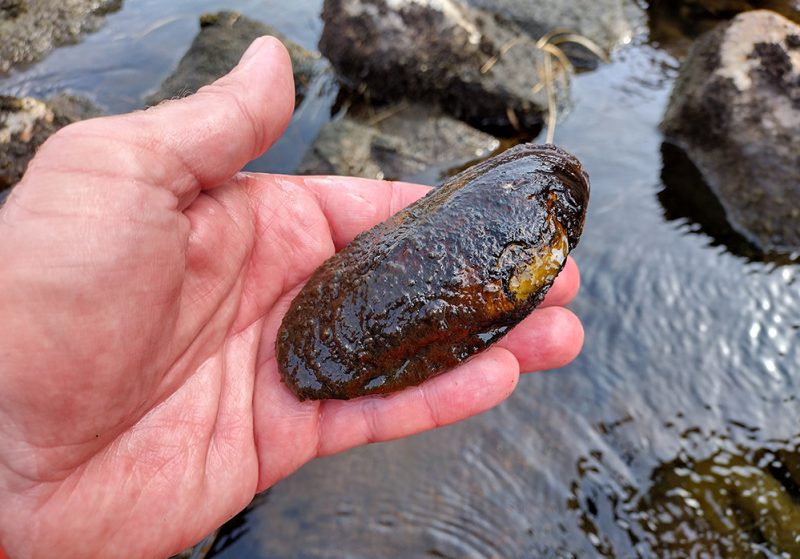
A freshwater pearl mussel

A freshwater pearl mussel survey map
APEM have a national field team with several individuals licenced to undertake detailed freshwater pearl mussel surveys.
An initial generalised survey is used to confirm the presence and once their presence is confirmed (the presence of a shell is enough to establish this), a full survey needs to be completed.
A transect survey method is often used if the population is not too large. Population estimates are then georeferenced and can be used as part of development work application.
The experts at APEM work with developers, environmental regulators and the aquaculture industry to mitigate their impact on protected species. We make recommendations for nature-based solutions that include boosting population, recruitment of more host salmonids and better habitat creation. By developing better channels, the population of freshwater pearl mussels can grow in safety.
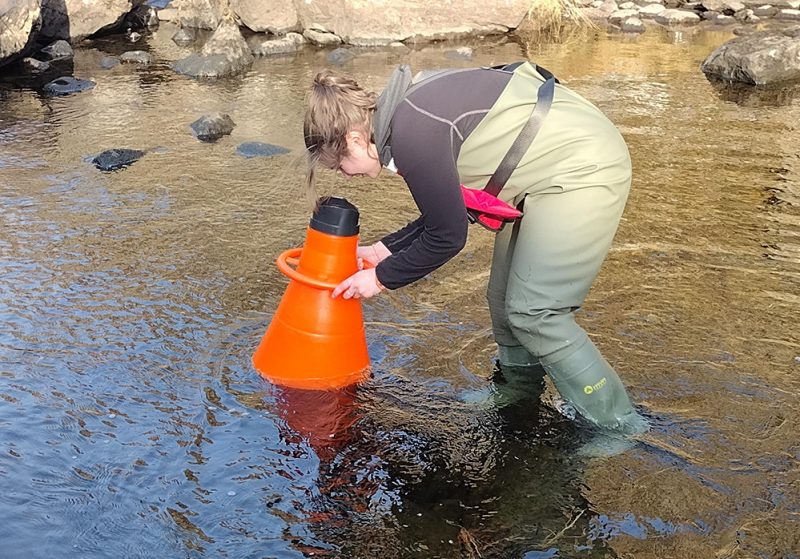
APEM field scientist using a bathyscope
The team at APEM would be happy to answer any questions you have. Please use the form below to get in touch.


