


News
APEM Announces Intention to Acquire Resource Strategies

By Richard Wells – Principal Environmental Scientist

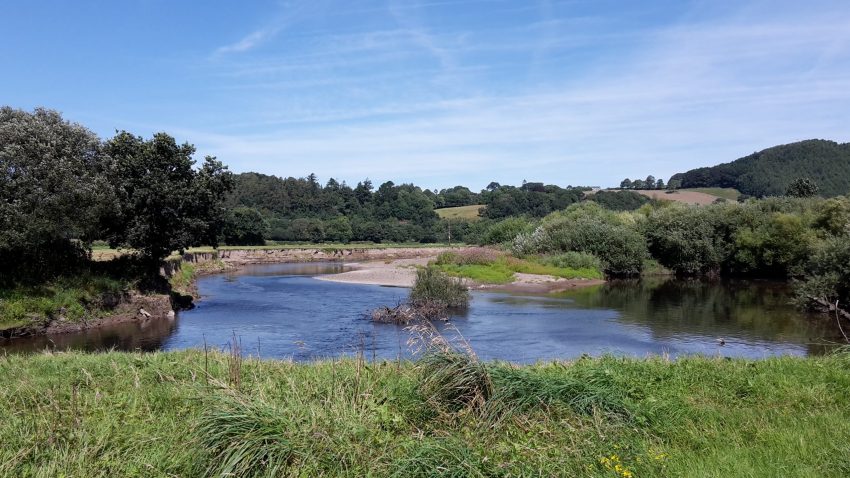
River Towy, Wales
All proposed developments that have the potential to impact a water body, require a Water Framework Directive Assessment.
In this joyously wet part of the world in which we live (note the rain lashing against the window as I write this blog), we are never far from a water body. Streams, rivers, lakes, estuaries, the coastal seas, never mind the groundwater beneath our feet are all ‘water bodies’ that are protected by an overarching piece of environmental legislation called the Water Framework Directive. Therefore any proposed development that has the potential to impact on a waterbody, is required to produce a Water Framework Directive Assessment.
The Water Framework Directive, or the WFD was a landmark piece of legislation first published in 2000. It has been built upon over the last two decades, and it underpins the vast majority of water related environmental protection in the UK and Ireland. Yes, it is a European Directive, but it is fully implemented into UK law and there are no signs that it will disappear any time soon post Brexit.
Large schemes have been undertaking WFD compliance assessments for some time (for example as part of Environmental Impact Assessment (EIA) studies) but the requirement is now routine and any development with potential to impact a water body is now obligated to carry out a Water Framework Directive Assessment. The old regime of flood defence consents and main river land drainage consents are now replaced by Environmental Permits and Water Framework Directive Assessment.
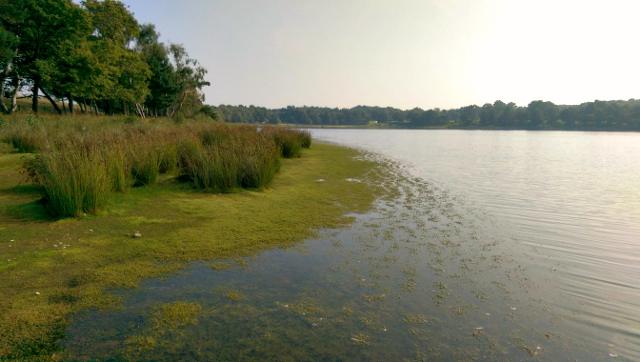
Oakmere Cheshire
What does a WFD assessment do?
The overall quality or ‘status’ of a water body is defined by the monitoring and classification of multiple ‘supporting elements’ and these can include physicochemical elements (e.g. temperature), hydromorphological elements (e.g. the flow regime), biological elements (e.g. fish and macrophyte populations), and chemical elements (e.g. heavy metals and pesticides). A WFD assessment should systematically consider the potential effects a development could have on each supporting element and demonstrate (with sufficient evidence) that there will be no ‘deterioration’ in status, or reduction in the potential for a water body to reach its objectives in the future.
WFD compliance assessment guidance differs for freshwater and marine waterbodies, but the approach advocated by regulators such as the Environment Agency, Natural Resources Wales, Environmental Protection Agency and the Northern Ireland Environment Agency is largely consistent. That said, each WFD assessment is different and the detail and focus of each depends on the characteristics of the local waterbody and the nature of the proposed development.
Over the years I have carried out WFD assessments on a huge range of development types, some small in scale such as pipe bridge crossings or bankside reinforcements, and some massive, such as capital dredge schemes and new nuclear power stations. Each brings its own challenges as an environmental consultant, some are relatively simple and might involve presentation of existing best practice design and planned mitigation measures using appropriate WFD language. Other more complex assessments have required development of innovative technical assessment methods.
For example, to assess the WFD effects of a large thermal discharge into a coastal water body, I assessed the effects of temperature increases on dissolved oxygen concentrations and on the fraction of dissolved ammonia that is poisonous to fish. To assess the effects of disturbance to known contaminated sediments (from a dredge scheme) on WFD water quality limits, I developed a tool accounting for the partitioning behaviour of individual contaminants.

New River, London
Regardless of the requirements of any future WFD assessment, I am supported by an extensive team of inhouse freshwater, marine and terrestrial experts at APEM that include:
So think again, how far away are you from a water body – does your development need a Water Framework Directive assessment? If it does you know who to call!
Get in touch to see how we can help your project with a WFD assessment.

APEM has entered into an agreement to acquire Resource Strategies, a leading independent environmental approvals consultancy in Australia.
+ Read more
APEM Group is pleased to announce that Ambiente S.r.l is now officially part of the Group.
+ Read more

CSA Ocean Sciences is now part of APEM Group, bringing together complementary expertise to strengthen global marine and coastal environmental insight.
+ Read more

APEM Group today announced that Ambiente s.r.l., an Italian environmental engineering and consulting company providing technical and strategic advisory services
+ Read more