


Blog
APEM championing consistency, reliability, and quality in mari...


APEM provides the contract management for the benthic invertebrate, fish, and particle size components of the North East Atlantic Marine Biological Analytical Quality Control (NMBAQC) scheme.
The NMBAQC scheme was set up in 1994 to provide quality control and assurance to the macrobenthic invertebrate elements of the Clean Seas Environmental Monitoring Programme (formerly the NMMP).
Its principal aim is to provide assessment of marine biological data contributing to UK national or European monitoring programmes. It also aims to develop and promote best practice in relation to sampling and analysis procedures through a range of training exercises, workshops and literature guides.
Two members of APEM’s team authored the current NMBAQC guidance for the processing of marine macrobenthic invertebrate samples. This guidance introduced the NMBAQC taxonomic discrimination policy (TDP) to define industry-standard data resolution and recording requirements. Our team is continuing to develop the TDP alongside the NMBAQC Committee.

The performance of all the participants is summarised in various bulletins and reports. In some exercises, participant samples are selected and assessed against scheme standards to determine whether sample batches achieve acceptable quality. Participating labs are issued annually with a Statement of Performance certificate.
Membership of the scheme continues to grow each year and its exercises are continually assessed by the NMBAQC committee to ensure that they are fit for purpose and offer value for money.
Participants include laboratories from competent monitoring authorities (CMA) in the UK, the Environment Agency, SEPA, Cefas, AFBI, DAERA NI, conservation agencies represented by the Joint Nature Conservation Committee and a number of independent environmental consultancies.
The benthic invertebrate component of the NMBAQC scheme concentrates on the processing and analysis of marine benthic macrobiotic samples, which could be cores or grabs, from marine or estuarine waters.

APEM co-ordinate the benthic invertebrate component of the scheme. The component modules include bi-annual Ring Test exercises, Own Samples, and Laboratory Reference. These modules are used both as training exercises and for assessment of a laboratory’s performance. All CMAs, and their contracting laboratories, that undertake statutory marine monitoring programmes – for example, Clean Seas Environmental Monitoring Programme and Water Framework Directive (WFD) – are required to participate in the NMBAQC scheme.
These laboratories must achieve targets for their data before it can be submitted to Defra’s MERMAN database.
APEM also manage the fish component, which includes ring test and reverse-ring test modules. Participant laboratories and fish monitoring teams improve the consistency and resolution of their fish data thorough these annual exercises.
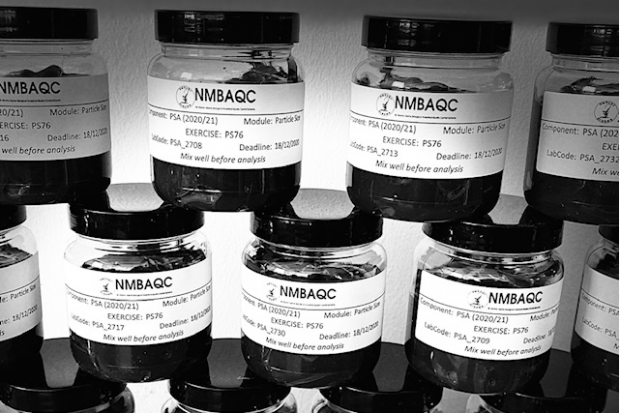
The particle size component comprises the analysis by participants of four pre-determined samples, usually including a mud, a gravel and two mixed sediments; additionally, there is an ‘own sample’ exercise requiring participants to submit samples analysed in-house for re-analysis.
APEM has successfully presented a number of expert workshops for the NMBAQC scheme. These workshops have ranged from providing basic training to expert-level training and the development of best practice methodologies.
The team at APEM would be happy to answer any questions you have about the NMBAQC scheme and APEM’s role. Please use the form below to get in touch.

Read one of APEM’s blogs, news articles or case studies to find out more.

The scientific community is full of acronyms; however, when it comes to quality control few are as important as NMBAQC
+ Read more
PS analysis plays a fundamental role in classifying sedimentary environments and has a wide range of applications in many fields
+ Read more